


Description
Hiunchuli Peak Climbing (also known as the Hiunchuli Trek)
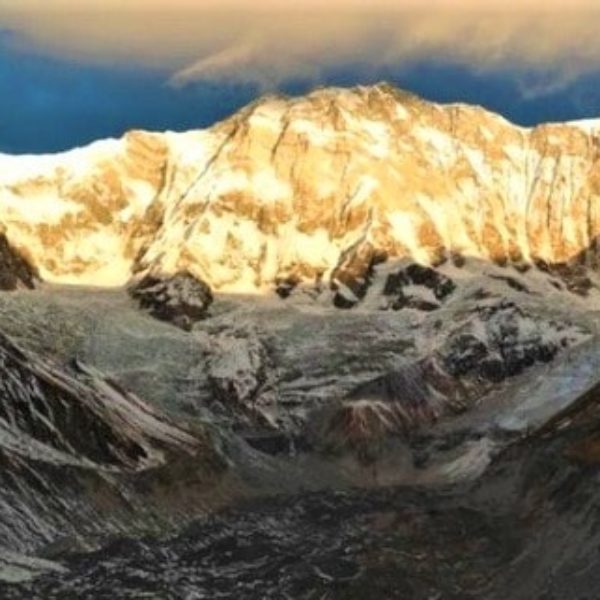
Hiunchuli (6,441m) lies in the Annapurna region, connected to Annapurna South (7,219m). It was first summited in October 1971 by an American Peace Corps expedition led by Colonel Jimmy Roberts via its south-east face. Access is relatively easy, following the well-developed trekking trail through the Annapurna Sanctuary – yet the mountain has always received comparatively little attention from climbers. Technically, Hiunchuli is not particularly difficult to climb, but it is vulnerable to rockfall, and route-finding can also be a challenge; depending on weather conditions there can be a significant avalanche risk too. For adventurous climbers, it still holds real potential for new routes. To reach base camp, you follow the Annapurna Sanctuary trekking trail up to Hinko, then climb a steep hillside to grassy meadows where base camp is established for the ascent via the south-east face (the normal route).
South-East Face Route: This is the “normal route”. Base camp is reached from Hinko Cave on the Annapurna Sanctuary trail. After the first camp above the valley, a further two camps are usually needed to reach the summit.
North-West Face Route: The ascent via the north-west face is less common among climbers, as it is trickier. The exact route depends on conditions and requires local knowledge as well as experience judging snow and mountain conditions. The approach is generally made from Annapurna Base Camp in the Sanctuary, with a further two camps usually required to complete the climb.
- Day 1: Kathmandu Arrival
Arrival in Kathmandu, transfer to hotel. - Day 2: Kathmandu Valley
Free day or sightseeing around Kathmandu Valley. - Day 3: Kathmandu – Pokhara
This is where the “Hiunchuli Peak Climbing” journey begins. Drive to Pokhara (850m). Overnight at hotel. - Day 4: Pokhara – Birethanti – Tirkhedhunga
Drive to Birethanti, on to Tirkhedhunga. - Day 5: Tirkhedhunga – Ghorepani
Tirkhedhunga – Ghorepani (2855m). - Day 6: Ghorepani – Poon Hill – Tadapani
Sunrise from Poon Hill, then on to Tadapani (2595m). - Day 7: Tadapani – Chhomrong
Tadapani – Chhomrong (1950m). - Day 8: Chhomrong – Dovan
Chhomrong – Dovan (2720m). - Day 9: Dovan – Machhapuchhre Base Camp
Dovan – Machhapuchhre Base Camp (3700m). - Day 10: Machhapuchhre Base Camp
Acclimatisation day. - Day 11: Machhapuchhre Base Camp
Acclimatisation day – hike to Hinko Cave. - Day 12: Hinko Cave – Higher Camp
Hike to higher camp (4100m). - Day 13: Higher Camp
Climb to high camp (4900m). - Day 14: Higher Camp
Higher Camp (5500m). - Day 15: Higher Camp – Summit – Base Camp
The last three days are deliberately scheduled with flexible timing, depending on conditions after acclimatisation. Climb to the summit (6441m) and back to base camp. - Day 16: Base Camp – Dovan
Base Camp – Dovan (2720m). - Day 17: Dovan – Jhinu Danda
Dovan – Jhinu Danda (1600m). - Day 18: Jhinu – Tolkha
Jhinu to Tolkha (1700m). - Day 19: Tolkha – Dhampus Phedi – Pokhara
Tolkha – Dhampus Phedi, then drive to Pokhara. - Day 20: Pokhara – Kathmandu
Drive to Kathmandu (1350m). - Day 21: Kathmandu
Free day or shopping. - Day 22: Departure from Kathmandu
Drive to the airport for your flight home. The “Hiunchuli Peak Climbing” trip comes to an end.
Included in the price:
- Two nights in a deluxe hotel in Kathmandu, bed & breakfast
- Peak climbing permit and one climbing guide (Sherpa)
- National park entry permit
- All airport transfers
- All meals during trekking and camping
- Lodge accommodation during the trek, basic camping arrangements while climbing
- Porters for members’ baggage (15 to 18 kg per person)
- Accident insurance for staff
Not included in the price:
- Personal clothing
- Personal accident insurance, emergency evacuation costs, oxygen, medical kit
- Alcoholic beverages, laundry and tips
- Extra hotel nights and sightseeing tours in Kathmandu (bookable on request)
Nepal Highlights:
Travel season in Nepal. Additional information on “Hiunchuli Peak Climbing”.
Nepal can generally be visited at any time of year. However, it’s worth noting that certain periods bring natural hazards, such as heavy flooding during the monsoon season (mid-July to mid-August) and extreme cold in the Himalaya (late November to mid-December).
Nepal is rich in hills and mountains. Its high peaks are one of the reasons the country has such abundant water resources – fast-flowing rivers and beautiful lakes. Heavy rain, even over just three or four days, can cause flooding in the lowland regions, so caution is advised when visiting these areas during the monsoon. Outside the monsoon, the hill regions typically enjoy sunny days even in winter, making that season pleasant and comfortable for travel.
Seasons in Nepal. Additional information on “Hiunchuli Peak Climbing”.
Nepal recognises six seasons: Basanta Ritu (spring), Grishma Ritu (early summer), Barkha Ritu (summer monsoon), Sharad Ritu (early autumn), Hemanta Ritu (late autumn) and Shishir Ritu (winter).
Aside from the monsoon (early July to late August), almost any season is suitable for a trip. Yetiland-nepal.de advises against travelling to Nepal’s terrain regions during the monsoon.
Summer can get hot, with temperatures ranging from around 25 to 40 °C depending on altitude. In the upper Himalayan region, summer temperatures can reach around 30 °C, while in the lower Terai region in southern Nepal they can climb as high as 40 °C.
Winter days are mostly sunny, with cooler mornings and evenings. If you’ve experienced winter in Central Europe, Kathmandu in winter feels somewhat similar – though from mid-December onward, while the sun keeps days warm, evening temperatures can drop to around 5 °C, and in the Himalaya well below 0 °C.
Buddha was born in Nepal. Additional information on “Hiunchuli Peak Climbing”.
This topic remains a point of pride for many Nepalis. Neighbouring countries, India in particular, sometimes claim Buddha originated there, which regularly sparks debate. In fact, Buddha was born in Nepal.
Well worth a visit is Lumbini, his birthplace southwest of Kathmandu. The prince who left his palace in search of lasting peace and meaning eventually attained enlightenment. His path has since been followed by millions of people worldwide. Even in today’s modern, Western society, Buddhism and meditation – a path to self-awareness, inner peace and ultimately enlightenment – have become popular everyday practices.
Take a look at our tours that include a visit to Lumbini.
8 of the world’s 10 highest mountains. Additional information on “Hiunchuli Peak Climbing”.
Nepal is home to 8 of the world’s 10 highest mountains: Mount Everest (8,848 m), Kanchenjunga (8,586 m), Lhotse (8,516 m), Makalu (8,485 m), Cho Oyu (8,188 m), Dhaulagiri (8,167 m), Manaslu (8,163 m) and Annapurna I (8,091 m). Yetiland-nepal.de offers the following categories for these regions: Expedition category – for booking a full expedition (suitable for experienced mountaineers only); Trek/Hike category – for trekking in these regions (considerably easier, offering mountain views from a much lower altitude, ideal for those who want to experience Nepal without climbing a peak); Holiday category – for leisure travel focused on enjoying Nepal’s nature and scenery.
One of the world’s most dangerous airports. Additional information on “Hiunchuli Peak Climbing”.
One of the most famous airports on the route to Mount Everest, Lukla, is considered one of the most dangerous airports in the world. Nestled between steep hills, it poses a major challenge for landing and take-off. Pilots speak of a “point of no return”, beyond which all preparations and technical alignment must already be complete for a safe landing. During peak season, thousands of passengers fly into this region every month – a truly unique experience. Nepali pilots are highly skilled, thanks to their extensive experience across almost all of Nepal’s hill regions.
New Year in Nepal. Additional information on “Hiunchuli Peak Climbing”.
Nepal has its own calendar system, known as Vikram Sambat (the current year is 2077, for comparison with the Gregorian calendar). Nepali New Year falls around mid-April, which is also early summer in Nepal. Many people also follow the lunar calendar for religious festivals and family celebrations. Various ancient legends explain the origins of the New Year. As Nepal is home to many ethnic groups, each with its own history, several local New Year dates also exist – a well-known example is Losar, celebrated among others by the Sherpa people.
A unique flag
Nepal’s flag is the only national flag in the world with a triangular (in fact, double-triangular) shape, featuring symbols of the sun and moon. These reflect the character of the Nepali people, who are exceptionally hospitable and welcoming toward visitors. In the hill regions, hosts will sometimes even slaughter their own livestock (such as chickens or goats) to show hospitality to their guests. The moon on the flag represents the modesty of the Nepali people, while the sun represents their courage. To this day, many Nepali soldiers – known as Gurkhas – serve in various regiments around the world.
A unique weapon
A handcrafted curved knife from Nepal, the khukuri, is famous worldwide. It was carried by Nepali soldiers and used in both World Wars. According to war veterans, Nepali soldiers fought with great effectiveness thanks to their courage and their use of the khukuri. These knives are also popular as souvenirs today.
Suspension bridges. Additional information on “Hiunchuli Peak Climbing”.
Nepal is known for its many suspension bridges spanning the gaps between hills. Since much of the country is mountainous, these bridges have long been a practical way to make life easier in the high-altitude regions. Even Germany, inspired by Nepal’s example, built a suspension bridge of its own – the Geierlay Suspension Bridge in Rhineland-Palatinate.
Landslides
Nepal is a very hilly and mountainous country. During the monsoon there is a risk of flooding, mainly in the flat Terai lowlands, where vegetation thrives year-round. Because Nepal is rich in water resources, rivers can swell considerably during sustained rainfall. Heavy rain can also trigger landslides in the hill regions, so it’s advisable to avoid travelling during the monsoon season.
Earthquakes. Additional information on “Hiunchuli Peak Climbing”.
Nepal is one of the countries at high risk of earthquakes. This doesn’t mean major earthquakes happen daily or even monthly, but history shows that a severe earthquake can be expected roughly every 50 years. The cause lies in the movement of tectonic plates: the Indian Plate shifts about 5 cm per year relative to the Eurasian Plate, gradually pushing the Himalaya upward – a process that unfolds over millions of years.
The April 2015 earthquake (magnitude 7.8, at a depth of 8.2 km) is one of the most recent major earthquakes, causing a huge humanitarian and economic disaster in this Himalayan nation. Around 9,000 people lost their lives and roughly 22,000 were injured.
Flying in Nepal. Additional information on “Hiunchuli Peak Climbing”.
The Civil Aviation Authority of Nepal (CAAN) is the governing body responsible for regulating aviation in Nepal.
CAAN – Nepal
Several airlines operate in Nepal, including: Yeti Airlines, Buddha Air, Himalaya Airlines, Simrik Airlines, Nepal Airlines, Saurya Airlines, Shree Airlines, Sita Air, Summit Air and Tara Air.
Helicopters can also be chartered for private use. Charter services are offered by, among others: Air Dynasty, Simrik Air, Prabhu Helicopters, Altitude Air, Fishtail Air, Manang Air, Makalu Air, Kailash Helicopter Services and Heli Everest.
Airports in Nepal
Numerous domestic airlines operate scheduled flights throughout the year. Nepal covers an area of 147,516 km², stretching around 880 km along the Himalayan axis and 150–250 km across. The average domestic flight takes 1.5–2 hours, meaning all of the country’s key airports are within about 3 flight hours of each other: Tribhuvan International Airport (Kathmandu), Tenzing-Hillary Airport (Lukla), Pokhara Airport, Simara Airport, Bharatpur Airport, Biratnagar Airport, Surkhet Airport, Nepalgunj Airport and Jomsom Airport.
Of these, Lukla is considered one of the most dangerous airports in the world – yet a truly unique experience for many. Thousands of travellers still use it every month.
If your Yetiland-nepal.de package already includes a flight, there’s nothing further for you to arrange.
During the winter season (November to December), early-morning flights are often delayed due to heavy fog and poor visibility. Travellers sometimes have to wait for hours, only for the flight to be cancelled for the day regardless. For this reason, yetiland-nepal.de typically offers tourist bus transport rather than flights during this season.
Similar tour to Hiunchuli Peak Climbing
Background info for Hiunchuli Peak Climbing


Reviews
There are no reviews yet.